South Africa's built environment faces a persistent and often underestimated challenge: ground instability beneath existing structures.
Whether driven by water infiltration, poorly compacted fill, expansive clay soils, or the gradual erosion of fine particles beneath foundations, the consequences — cracking walls, settling floors, sticking doors, and structural distress — are familiar to engineers and asset owners across every sector of the construction industry. By Antonio Pappalardo, Director — GeoPoly Systems SA
Over the past 15 years, GeoPoly Systems SA's team has developed extensive practical expertise in geopolymeric ground engineering across a wide range of South African ground conditions and infrastructure environments. Today, GeoPoly Systems SA operates as a fully independent South African specialist contractor, delivering engineered geopolymeric ground improvement solutions tailored to local site conditions and operational requirements.
Drawing on years of in-field application experience, GeoPoly Systems SA delivers independently developed ground engineering solutions under the GeoPoly Precision Densification™ and GeoPoly Multi-Level Densification™ platforms — refined through practical application across residential, commercial, industrial, mining, and infrastructure sectors throughout Southern Africa.
How the material works
GeoPoly Precision Densification™ utilises a two-component expanding geopolymeric material system introduced into targeted subsurface zones through small injection points. Once activated within the soil matrix, the material expands in a controlled manner - filling subsurface voids, displacing trapped water, compacting loosely consolidated particles, and improving contact between the soil and supporting structures.
The process increases the density and stiffness of weak foundation soils while restoring support conditions beneath slabs, foundations, and infrastructure elements. The material achieves rapid early strength gain, allowing fast return to service in operational environments. Once cured, it is dimensionally stable, moisture resistant, and suitable for use in water-affected and environmentally sensitive areas.
Geopoly vs conventional methods
The construction industry has traditionally relied on underpinning, piling, excavation, and cementitious grouting to address foundation instability and slab settlement. While these methods remain suitable in certain applications, they often involve significant disruption, extended construction periods, and substantial reinstatement costs.
Conventional underpinning typically requires excavation beneath existing foundations, demolition of slabs and finishes, lengthy curing periods, and reinstatement of paving, landscaping, and drainage infrastructure. In occupied buildings, these processes may significantly disrupt operations and occupants.
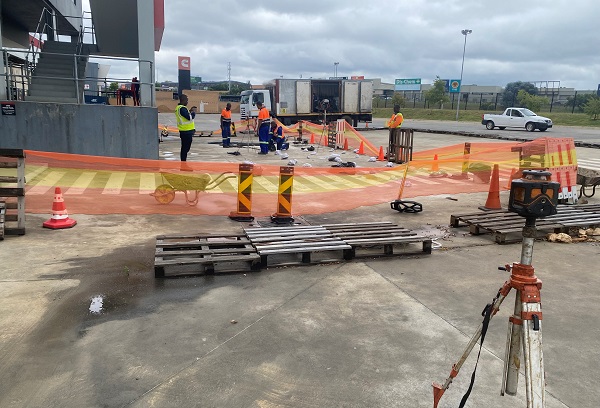
GeoPoly Systems SA's geopolymeric stabilisation methods offer a non-invasive alternative in many applications. Using small access ports, geopolymeric material is introduced directly into weak subsurface zones - without excavation, without heavy construction equipment, and without damage to surrounding surfaces. In many cases, works can be completed within hours or a single working day while facilities remain fully operational. The process is monitored in real time using precision laser equipment to ensure controlled densification and accurate slab re-levelling where required.
Points to remember
• Geopolymeric ground improvement addresses the underlying soil support conditions rather than bypassing the problem
• Works are typically completed rapidly with minimal disruption to operations and occupants
• No excavation means reduced damage to paving, landscaping, and surrounding infrastructure — and no reinstatement costs
• Occupants and operational facilities can often remain fully functional during the works
• The material system performs effectively in wet or moisture-affected ground conditions
• GeoPoly Systems SA brings 15 years of practical South African field experience in geopolymeric ground engineering
• Every project begins with site investigation and is monitored throughout the stabilisation process