Classroom lighting upgrades are often treated as routine maintenance projects — a straightforward replacement of outdated fluorescent fittings with modern LED technology. In reality, these retrofits pose a far more complex engineering challenge, shaped by ageing infrastructure, compliance requirements, procurement limitations, and long-term maintenance considerations.
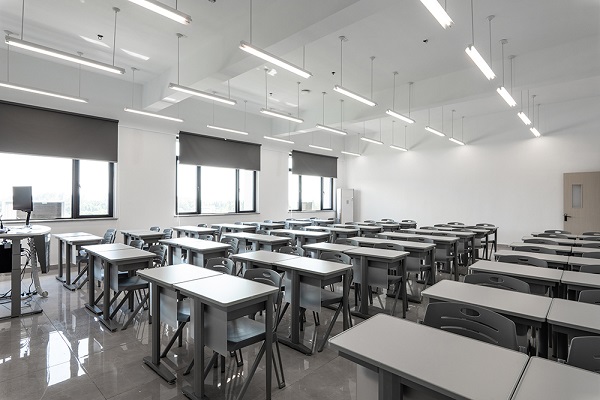
Within public-sector facilities, the success of a lighting upgrade depends not only on the performance of the selected luminaire but also on how effectively the solution integrates with the constraints of the existing environment.
At GIBB, these projects continue to underscore the importance of balancing technical compliance, practical implementation and long-term operational sustainability within the existing educational infrastructure.
Working within existing infrastructure
One of the biggest challenges in upgrading classroom lighting is the condition and configuration of the existing building infrastructure.
Many older educational facilities were designed around fluorescent lighting systems installed within skimmed ceilings, with limited ceiling void space. These environments offer little flexibility for modification, particularly where surface-mounted fittings and ageing electrical reticulation systems are involved.
As a result, the existing installation often dictates the replacement solution more than modern design preferences.
Mounting positions, fixing points, wiring entry locations and restricted ceiling access all influence which luminaires can realistically be installed without extensive building alterations. While recessed LED systems may offer attractive performance characteristics, they are often impractical where ceiling modifications are not feasible.
Retrofit projects, therefore, frequently require adaptable surface-mounted solutions that integrate with existing infrastructure while meeting modern performance expectations.
Compliance is more than wattage replacement
A common misconception in retrofit projects is that replacing a fluorescent fitting with an LED equivalent automatically ensures compliance.
Although LED luminaires provide improved efficiency and reduced energy consumption, compliance with standards such as SANS 10114-1 still depends on several critical performance factors, including illuminance levels, uniformity and glare control.
Differences in beam distribution, lumen output and luminaire spacing can significantly affect classroom usability and occupant comfort.
One of the most frequently overlooked considerations is glare control, typically assessed through Unified Glare Rating (UGR). In many retrofit scenarios, fittings are selected primarily based on lumen output or wattage equivalence, without a detailed photometric assessment.
This can result in installations that technically meet lux-level requirements while creating uncomfortable visual environments for learners and educators.
The challenge highlights the importance of evaluating lighting performance holistically rather than relying solely on simplified product substitution.
Balancing standardisation and practicality
Public sector projects also place strong emphasis on standardisation.
From a maintenance perspective, facilities often aim to minimise spare-part variations, simplify maintenance procedures, and reduce attic stock requirements by standardising luminaire selections across multiple sites.
However, the ideal fit for a new-build installation is not always suitable for retrofit applications.
This creates a balance between compatibility with legacy infrastructure, long-term maintenance practicality and future-focused lighting design. In many cases, the final solution is a compromise that performs adequately across both new and existing facilities, rather than optimally in either environment.
Product availability still shapes design decisions
Engineering decisions are also influenced by product availability and supply chain constraints.
Many luminaires originally installed in older educational facilities are no longer manufactured, and direct replacements are often unavailable. Even where modern alternatives exist, differences in physical dimensions and mounting arrangements can complicate installation.
To address this, projects may favour adaptable luminaire designs that accommodate both LED and fluorescent technologies. While this approach improves flexibility and supports maintenance continuity, it also reflects the transitional reality that many facilities face as they move from legacy fluorescent systems to fully integrated LED infrastructure.
In practice, product selection is influenced not only by engineering requirements, but also by availability, procurement constraints and anticipated end-user maintenance capabilities.
Procurement and site constraints
Public sector procurement processes introduce another layer of complexity.
Specifications are often developed before detailed site conditions are fully understood. Once tenders are awarded, there is typically limited flexibility to adapt specifications to suit unforeseen installation constraints encountered during implementation.
This can create a disconnect between the intended design solution and what is practically achievable on site.
Successful retrofit implementation, therefore, depends heavily on early-stage technical assessments and realistic consideration of existing infrastructure limitations before procurement is finalised.
Maintenance and lifecycle considerations
While LED technology offers longer operational lifespans and improved energy efficiency, maintenance considerations remain critical.
Many modern luminaires incorporate integrated drivers and non-replaceable components, which may require full luminaire replacement in the event of failure. In environments with limited maintenance budgets or technical resources, this has significant implications for lifecycle costs.
For this reason, maintenance teams often favour simpler like-for-like replacement strategies that minimise the immediate risk of installation and operational disruption.
However, while this approach may simplify short-term interventions, it can also limit opportunities for long-term optimisation and efficiency improvements.
More than a lighting upgrade
Classroom lighting retrofits are not simply technology upgrades. They are infrastructure integration projects that sit at the intersection of engineering compliance, legacy constraints, procurement realities and long-term maintenance strategy.
Achieving successful outcomes requires more than selecting energy-efficient luminaires. It requires understanding the operational environment, the limitations of existing infrastructure, and the practical realities of implementation within public-sector facilities.
As the industry continues transitioning toward more efficient lighting technologies, retrofit projects will increasingly demand solutions that balance technical performance with real-world practicality.